

Early-career software engineers face an existential job market and it's no longer a debate.
Since ChatGPT released two years ago, employment for software developers under 25 has dropped nearly 20%, yet headcount for those over 30 has held steady or climbed.
A new working paper out of Stanford suggests this is a structural, lasting change to the economy and not a blip.
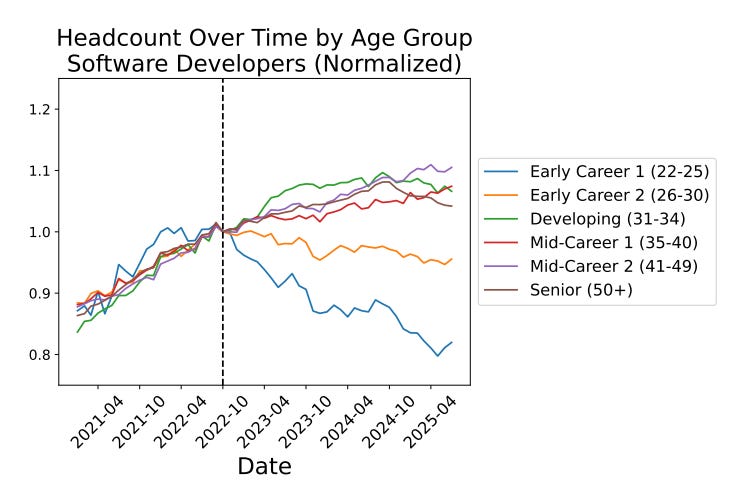
Generative AI automates much of what used to be done by entry-level programmers. The debugging and documenting and other boilerplate duties that fill the day of a junior developer can now be handled by large language models.
As a result, new grads who once filled these roles are competing for a shrinking pool of jobs.
What’s striking, too, is just how insulated older, more experienced engineers have been during the same period.
According to the paper, AI has implicitly put a premium on "on-the-job" wisdom.
Companies seem to be hiring for the tacit knowledge — judgment, management, interpersonal skills — that comes from experience, rather than credentials or raw technical ability.
AI, in effect, has made it harder for newcomers to latch onto the bottom of the career ladder, while reinforcing those who were able to get on a few years prior.
It also doesn’t help that Gen Z endured the COVID-19 pandemic, which some evidence suggests had a more nefarious second-order effect of mass-stunting of soft skills.
[You can read more about Gen Z’s economic malaise here.]
In any case, the researchers did find evidence that this phenomenon seems particularly insidious for software developers.
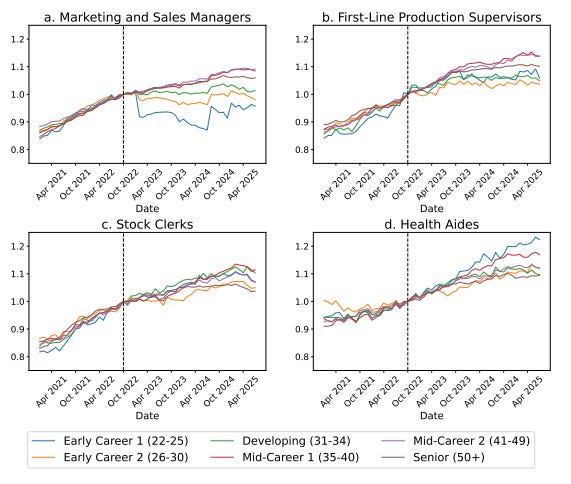
Young people’s unemployment rates relative to older peers did not decline to the same degree across sectors like first-line production supervisors, stock clerks, or health aides.
Marketing and sales managers, though, by virtue of being more exposed to AI displacement, saw similar generational splits.
It’s also worth noting that young people across all industries do face a more challenging outlook for jobs than their older peers, as the chart below illustrates.
As the Stanford team put it: “Economy-wide employment continues to grow, but employment growth for young workers has been stagnant.”
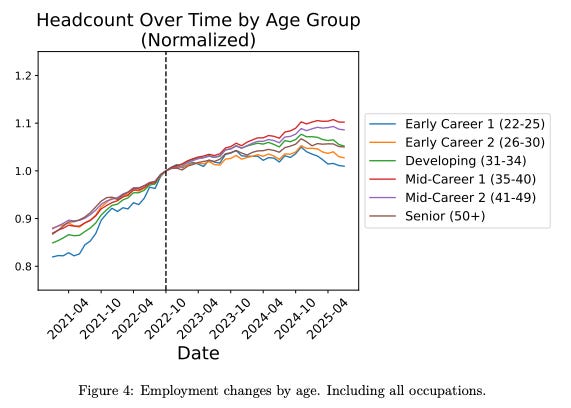
Even that divergence started when ChatGPT arrived in November 2022. It marked the first domino in the mass adoption of AI.
All evidence now points to an acceleration rather than a reversal.
To be sure, this shift opens up new opportunities for the young people who are most fluent in AI. Many of the most innovative startups of the last two years were launched by teenagers using ChatGPT.
For them, the collapse of traditional entry-level roles offered an invitation to build great products and businesses.
Still, the broader job market data is not ambiguous.
The “junior developer” role that once gave novice, inexperienced engineers their wedge into the industry is disappearing.
For everyone’s sake, whatever replaces it better be something young people find worthwhile.
Phil Rosen
Co-founder & Editor-in-Chief, Opening Bell Daily
Thank you for reading. If you enjoyed this post, consider hitting the “like” button to help boost visibility. If the ideas resonated, I’d love to hear why — reply directly to this email or leave a comment below.