

I recently met a high-level engineer at a legacy technology company.
He’s worked at the same place for eight years.
During his first few years at the company he would conduct two or three interviews a week, meeting potential hires for the engineering team.
Over the last year, however, he said those calls have “fallen off a cliff.”
He now does just one or two interviews per quarter.
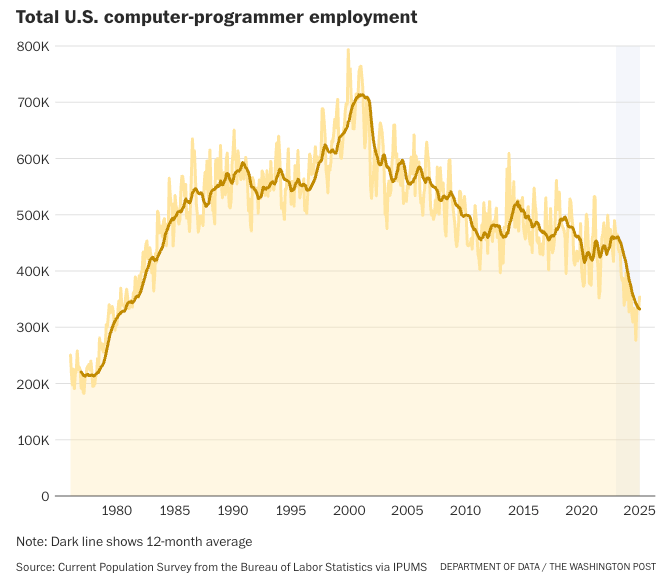
Indeed, there are now fewer programmers in the US today than at any other point since 1980, according to the Bureau of Labor Statistics — and that’s across a four-decade stretch when America’s total workforce has nearly doubled in size.
I had this conversation a few days after I read the new working paper out of Stanford detailing how employment for young software developers has dropped nearly 20% since ChatGPT came out in November 2022.
That, according to the researchers, is a structural shift that’s more likely to accelerate than reverse as technology gets smarter.
As I wrote last week, generative AI automates much of what used to be done by entry-level programmers. The boilerplate tasks that were once relegated to junior developers can now be handled by large language models.
As the tech employee I met confirmed, the on-ramp to a career in software engineering is narrowing fast.
Remember, for decades this path was straightforward and foolproof:
Get a computer science degree
Land an entry-level job
Build skills as support staff on simple projects
Earn promotions to senior roles
But if ChatGPT is taking on an increasing share of that early work — in college and on the job — the pseudo-apprenticeship model breaks down.
I’ve observed a similar occurrence across media and finance too, albeit to a less severe extent.
Of course, the US economy across the board is adding fewer jobs every month.

Innovative technology has always displaced jobs (lamplighters were undoubtedly upset at the advent of the light bulb), though what’s different this time is that, for many, the floor is falling out before their careers even start.
To me, the danger here isn’t just declining employment for new grads, but a hollowing out of the talent pipeline entirely.
No novice engineers today means no seasoned veterans tomorrow.
The engineer I met likes his job, gets on with his colleagues, and still enjoys conducting the increasingly rare interview.
He, like myself, sees the irony of the moment.
The AI tools that make him more valuable than ever are the same ones wiping out jobs for anyone who wants to follow in his footsteps.
Phil Rosen
Co-founder & Editor-in-Chief, Opening Bell Daily
Thank you for reading. If you enjoyed this post, consider hitting the “like” button to help boost visibility. If the ideas resonated, I’d love to hear why — reply directly to this email or leave a comment below.