

Good evening, my friends!
I’m writing to you from an airplane somewhere above Colorado. I’d planned to nap on this flight but I had something in my head I just had to put on paper…
I have been experimenting aggressively with AI for the last two years.
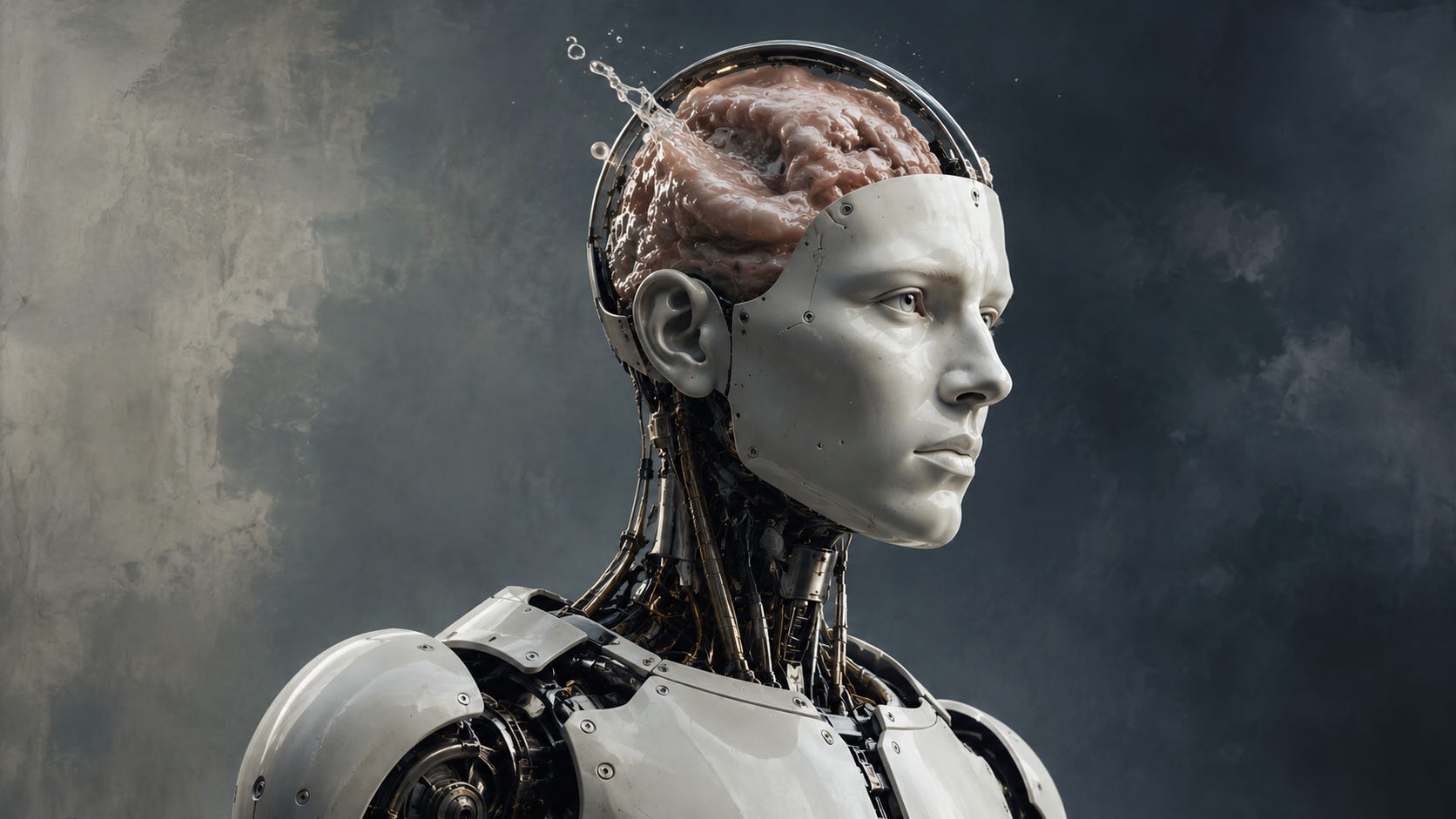
As much as it can supercharge productivity, I believe these tools risk making its users much dumber.
Rather than optimize for new skills or knowledge, AI pushes us to normalize — and so, seek out — increasingly quick fixes and low-friction outcomes.
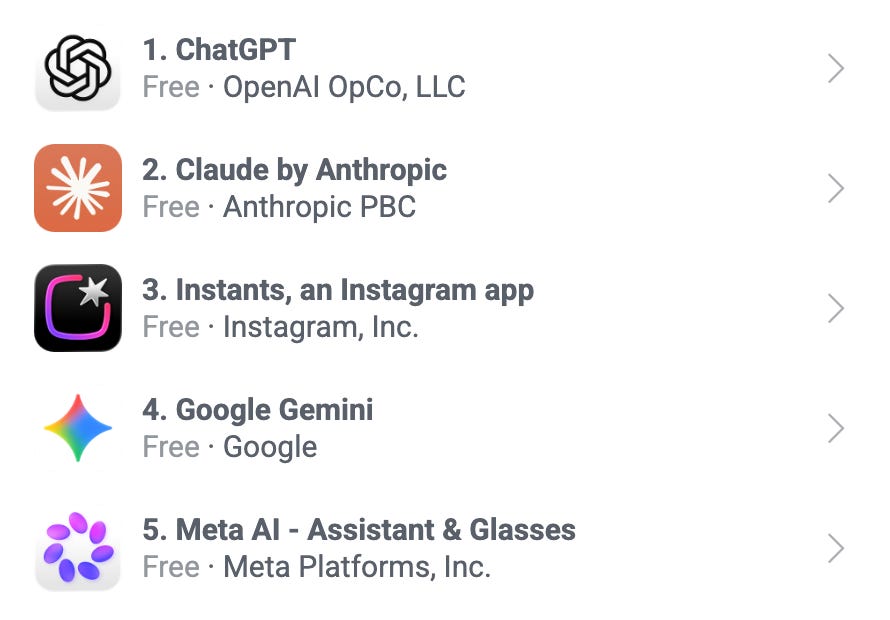
In this sense, four of the five most-downloaded apps in Apple’s App Store effectively encourage you to bypass the difficult mental processes necessary to produce genuine understanding and independent thought.
I say this as someone who works at cutting-edge of AI and investment research.
With a team of engineers at ProCap Financial, I deploy AI agents each day to parse economic data, analyze stocks, pull SEC filings to produce robust research reports.
Our system can do all this in, quite literally, 1% of the time versus a comparable team of human analysts inside a legacy financial firm.
I am bias, but the results are remarkable.
The AI agents routinely surface investment ideas sophisticated enough to rival those from the leading investors and portfolio managers I interview on my show each week.
The technology just works.
But again, the allure of a more productive work day shrouds the risks in the tools.
While I don’t worry about mass white-collar unemployment or a Terminator-like war with the machines, I am increasingly troubled by the hijacking of our mental capacities.
I’ve also become particularly grateful that I went to college and entered the workforce before AI proliferated.
Because I’ve published thousands of articles the old-fashioned way, I entered the AI era with sufficient judgment to use AI as leverage without letting it replace the underlying thinking or skills.
Researchers at Berkeley published a new paper that found university professors have handed out 30% more A’s since ChatGPT debuted in November 2022, with a particular uptick in classes with more writing and coding.
After analyzing 500,000 grades from 2018 to 2025, they concluded that grade inflation “may also weaken human capital development if students, receiving higher grades, overestimate their mastery and underinvest in foundational skills.”
The researchers continued:
More broadly, if AI displaces skill-building tasks during learning, students may graduate with weaker capabilities in precisely the domains where AI is strongest, reinforcing a feedback loop between AI in education and AI in production that could accelerate automation and widen skill gaps in the labor market.
Indeed, competence has always been tied to friction — a lesson particularly important for young people.
But thanks to AI, producing high-quality work no longer requires the same repetition or concentration.
Now, it’s entirely possible to scale a learning curve without learning anything.
The worst part of all this, which the Berkeley researchers pointed out, is that these tools create the illusion of understanding. Fake fluency without true comprehension, included with an affordable monthly subscription to your app of choice.
Why struggle through a crappy first, second and third draft of an essay when ChatGPT can do it for you?
Why memorize anything when perfect retrieval is cheap?
It’s funny, thinking through the power of AI has made me more protective of the human parts of my work.
I still write my own financial column each day.
I still host a human-to-human interview show.
And this blog, of course, remains 100% human.
If you’ve followed my work for awhile, you know how much I value writing as a craft.
Writing teaches you how to think. It’s the one skill that’s upstream from everything else.
Without sitting to write each day, it’s plausible that I would gradually switch all my brain work from critical thinking to mere management and orchestration.
Tom Slater, an investment manager with Baillie Gifford, captured the idea in a recent essay:
Just as literacy gave us something new by repurposing something old, AI is reshaping the brain’s allocation of cognitive resources. The trade may be worth making. But right now, most people are making it without realising there is a trade at all.
I hope you don’t think I am a luddite for publishing this piece.
AI can absolutely turn you superhuman. That’s why I use it every day.
You should master it as soon as possible to unlock your time and do great work.
Just don’t turn your brain to mush in the process.
Phil Rosen,
Co-Founder & CEO, Opening Bell Media
Chief market strategist, ProCap Financial
Something I will share with students! (Now get that nap, Phil! You earned it.)