

The internet is a strange place but it’s about to get exponentially weirder.
On Thursday, Google unveiled a new version of its AI model Gemini, which has made waves specifically for its updated image generator, Nano Banana.
I spent an hour on it this weekend and I can confirm it is literally unbelievable.
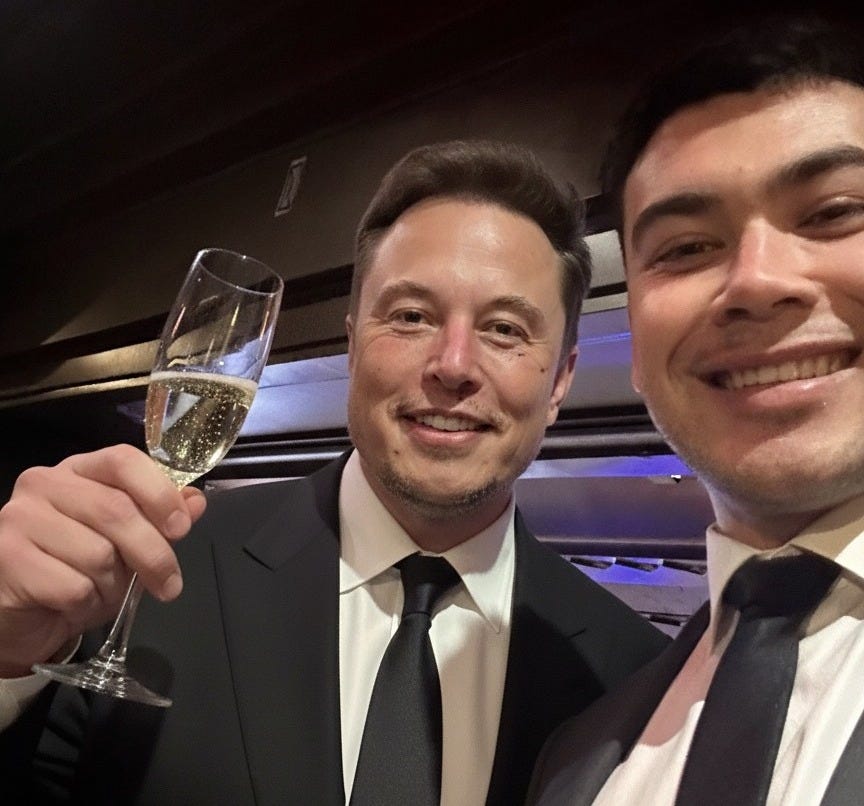
I uploaded a selfie of a friend and me, asked it to swap in Elon Musk, and I had a new photo about 10 seconds later.
This tool is currently the worst it will ever be.
Google reported in August that Gemini had 650 million monthly users — 200 million more than what it reported in July. My guess is that this new update will usher in millions more in the coming weeks.
As more people use and therefore train the AI on their data, this thing is going to improve faster than our reptile brains can comprehend.

Its only limitation is the imagination of its users, and that might just be the part nobody is ready for.
Synthetic AI-generated content is already indistinguishable from human-created content, but the tools to generate the former are becoming cheaper and more democratized.
This extends to videos, voices, and personas, all done in minimal time and at zero marginal cost.
It’s only a matter of time (maybe it’s already happening under our noses) that we see entire organizations or newsrooms powered exclusively by AI.
This brings us to the “Dead Internet Theory.”
The idea has circulated in conspiratorial corners of the web for a decade, but it’s becoming increasingly relevant.
In simple terms, it claims that most of the internet hasn’t been human-generated for years — that bots, automation and algorithms make up almost everything we encounter online.
Here’s what Google’s new Gemini model came up with when I asked it to “create an infographic that explains Dead Internet Theory.”
Nano Banana made this in about 15 seconds.
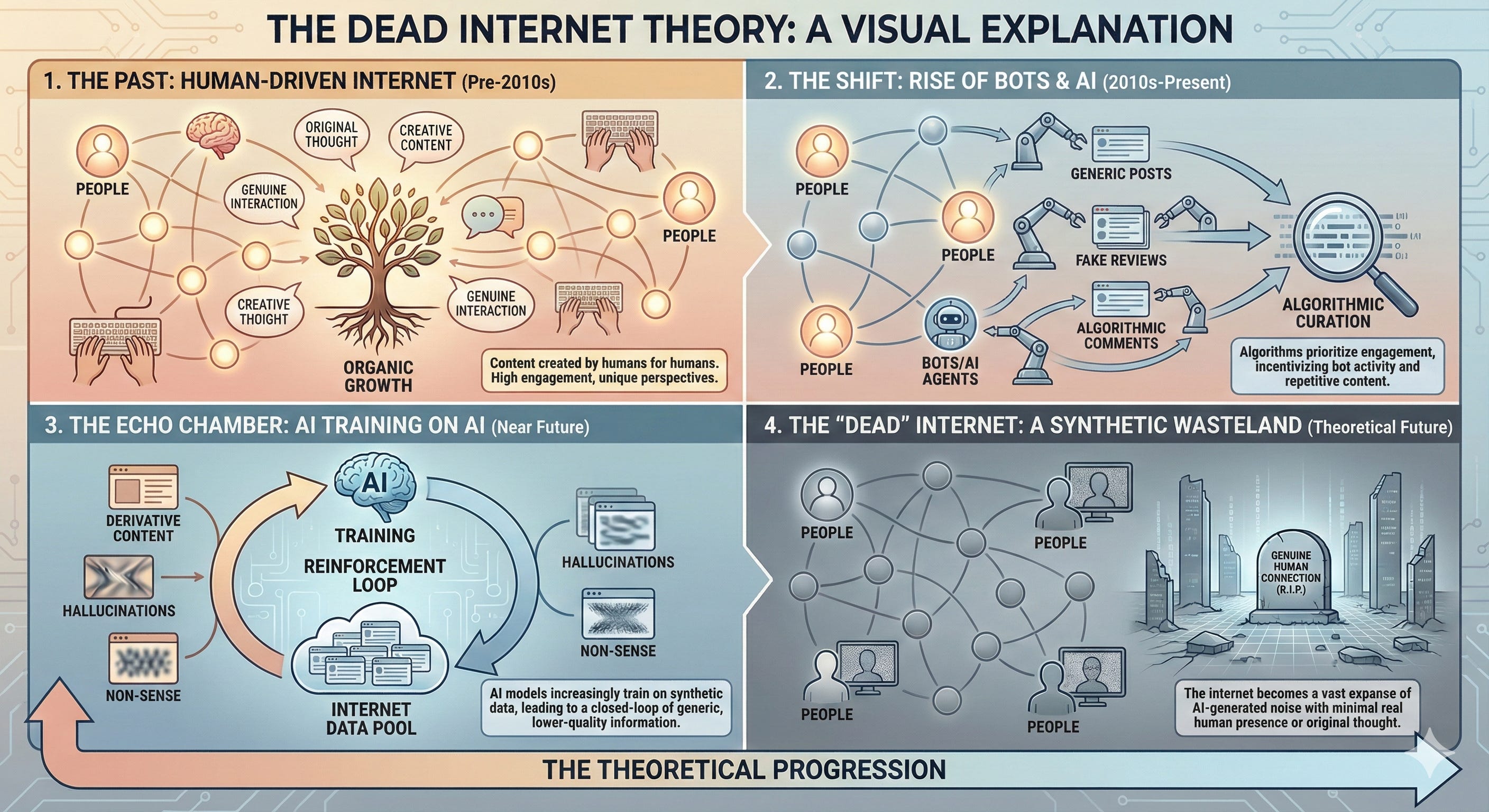
According to the theory (which, again, predates ChatGPT), the volume of machine-made content far outpaces that of human conversation, creating the illusion of a vibrant internet community.
The people warning about this a decade ago now seem like prophets.
I texted the above photos to a handful of friends and only about one-quarter of them called them out as fake.
Everyone else was convinced I’d been at some celebrity cocktail hour.
What’s troubling is how easy, cheap and fast it was for me to create fictional photos. It would have taken me longer to physically take those selfies in real life.
The amount of content a human can produce grows linearly, manual post by manual post.
Yet AI-generated content has no human bottleneck. Its volume grows exponentially.
That will be especially true when synthetic content itself becomes capable of generating more synthetic content.
My friends and I already talk about seeing AI-generated videos on our social media feeds. If we aren’t there today, at some point there will be less human-made content on the internet than the alternative.
Once those lines cross, the texture of the internet will change.
But the AI tools will be so skilled and the content so convincing that we may not even notice.
Phil Rosen,
Co-founder of Opening Bell Daily & Host of Full Signal
Thank you for reading. If you enjoyed this post, consider hitting the “like” button to help boost visibility. If the ideas resonated, I’d love to hear why — reply to this email or leave a comment below.